Categories
Meditation Philosophy Poetry

Impermanence

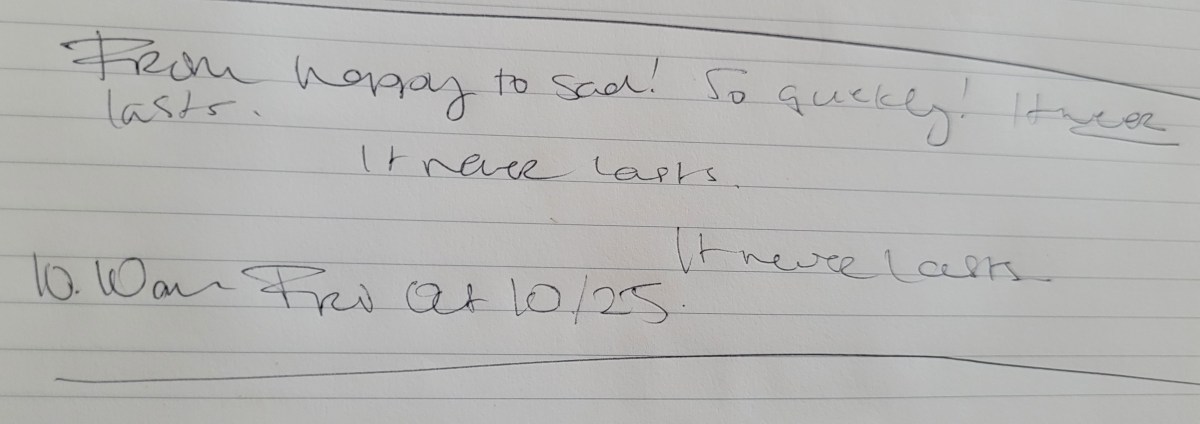
from happy to sad

                       so quickly

it never lasts

                 it never lasts

                                it never lasts
                                

Categories
Buddhism Good Fortune Meditation Monday Motivation Philosophy

What follows is a lengthy collection of (half) wisdom

In Buddhism, the Peacock is considered an auspicious bird for it thrives on plants and berries that would typically be poisonous to other birds. Just as peacocks live off toxic plants, so can a Buddhist practitioner thrive on adverse events by transforming them with Buddha’s teachings. This has been my practice since Winter of 2016 when I started General Program Meditation Classes with Samudra Kadampa Buddhist Centre.

from “About

Today, as I received my peacock tattoo (created and tattooed by the talented and amazing Ally “Peacock” Sweitzer-Koabel), as a reward for transforming the (somewhat adverse) events of my summer (and beyond), I was able to look back on a particularly “interesting” and transformative (trying not to say “difficult”) time in my last decade and rejoice in the progress I’ve made in taming my previously wild & uncontrolled mind into a calm, happy, loving one.

I even came across this journal entry-cum-quasi-article I started back in 2023 after our Foundation Program (FP) class finished studying the amazing text Meaningful to Behold, a commentary to the great 8th century Buddhist Master Shantideva’s Guide to the Bodhisattva’s Way of Life. What follows is how I applied Dharma before and while studying this text after a particularly difficult break-up, during a particularly challenging time in my life, some time ago now.

This is my personal experience and does not necessarily reflect the experience of other practitioners. This experience was encouraged by understandings I attained by participating in the NKT study programs and attending NKT celebrations and festivals whenever possible. I was able to quickly develop understanding of several basic concepts over my first three years of study and practice in FP (and seven years of meditation practice) to gain the following results.


How I’ve applied the Dharma instructions to change my “reality” 

I loved reading Meaningful to Behold, because it is such a wonderful and practical Guide to living our Modern Lives as aspiring Bodhisattvas. As an aspiring Bodhisattva, one of the first things I did was change my aspiration while remaining natural (which I was fortunate to understand when I met FP class and studied my first Buddhist commentary text, Universal Compassion). 

The approach I took to remaining natural while adding a Bodhichitta motivation was through conventional work – something I had grown to despise. 

By changing my motivation, I was able to use “getting a job” and “going to work” as a vehicle for progressing along the spiritual path. My motivation had changed, and I was still doing something that helped me function “naturally” as a part of normal society.

  1. When looking for a job in 2019 (before starting FP), I wanted to create the conditions for a life where I could access more Dharma and become closer to being a “good” person. I applied for a job as a dishwasher because I thought it would be humbling.
    I needed money (conventionally), so I had to get a job. But I changed my motivation and applied for something of commonly “lower” status and pay than my last several jobs (Event Planner, Volunteer Coordinator, Store Manager, etc) in order to align with my idea of what a Bodhisattva was at the time (compassionate, unattached to reputation, humble). I began to apply many Buddhist fundamentals that I was learning in 2020 before leaving that job in 2021. It was a rewarding, if frustrating, experience. 
  2. When looking for a job in 2021, I was still determined to make this a vehicle for progress on the path. I applied for a job where my neighbour worked. He described it as negative and terrible, and I felt very motivated to alleviate his suffering and the suffering of his coworkers by taking a job there. I began another humbling role, this time with a bit purer motivation (but perhaps greater stupidity ignorance).
  3. Prior to starting this job, I had also been contemplating and striving for fearlessness. This allowed a lot more flexibility in my practice as my aversion to confronting my ordinary fears was significantly weakened already. I was also able to dispel many fears through the practice of contemplating the emptiness of fear. 
  4. My perception of the workplace was that the work was easy and fun, but the people who worked there were making things terrible. There was a lot of crude, sexual joking that would have people instantly fired from my previous workplaces. There was nearly relentless complaining from almost every employee.  Every single issue was someone else’s fault, according to any complainer.
    I was overwhelmed by the negativity and tried to escape the situation almost immediately by searching for another new job.
    Very quickly, I received signs that I was exactly where I was supposed to be (not able to escape to another employer), so I continued my work as an aspiring Bodhisattva. (Although it took me some time to accept this). 
    I had to tackle this situation with many different Dharma tools I had accumulated:
    1. Patient Acceptance: Whatever was arising, I had to first accept it. Whether it was an unpleasant task at work, or the annoying environment at work or any other negative karma arising, too late to “stop”. Using a part of my mind to complain or wish it away was a waste of energy and absolutely no benefit.
    2. Understanding Karma: Whatever negative feelings were arising in actuality had NOTHING to do with how “terrible” my coworkers appeared. Everything I was experiencing was a result of my own previous actions. 
      (Good actions produce good effects. Bad actions produce bad effects.)
    3. Purification: as a result of understanding Karma, I knew I had to continue practicing “purification”, something I was familiar with engaging in while at my last job. It was becoming clear, no matter how many times I quit a job and started a new one, I would continue to experience almost exactly the same obstacles until the actual cause was purified.
      As a result of this understanding, I spent much time performing the four point purification practice, including regretting the negative actions I performed in lifetimes where I was a terrible boss, coach, mentor, absent parent, cruel ruler, betrayer, etc, etc. I knew that I would have to engage in the opponent power, virtuous actions, to oppose these negative actions and also to familiarize my mind with kindness, compassion, love — spontaneous virtue.
      I was also working on purification of finances, as it has become evident how many lifetimes I have spent as a miserly thief. I make special efforts to see the imprints arise (desiring to not pay for something at the store, not wishing to share with others), and I remember the effect that such a mind will produce in the future.
      I then destroy the delusion and make a promise to continue to weaken my familiarity with non virtue, seeing the connection between the imprint and my current dream appearance. 
    4. Effort & Mental Alertness: It has taken much effort to be on guard, disciplined and remain motivated. I have become an expert in self-encouragement and improving my mindfulness. It was clear that relying on external praise as a crutch was not working. I would either not receive it when I desired it. Or I would receive praise, and it would not stimulate the happy feelings I wish would arise. (As praise is never the actual cause of a happy feeling).
      After applying effort to attend every single Dharma class/event/course I was physically capable of attending, much wisdom was revealed about self-encouragement, and early on I was able to motivate myself along the path. This effort is also fueled by successes I continue to have along the path. This effort goes hand in hand with practicing mental alertness, so I am constantly on guard to what is arising in my mind. 
    5. Patience: I had to develop a strong kind of patience working for this employer. At the workplace, two coworkers in particular had a special negative influence on my mind. It took much contemplation and applying of Shantideva’s instructions in order to develop not just patience but absolute appreciation for these coworkers who would do things like be excessively negative, engage in bullying behaviour, act in hypocrisy, perform less work than others, all while willfully engaging in harmful actions. I was eventually able to be happy I received not one, but many Atisha’s Assistants. 
    6. Compassion: Watching these negative coworkers really awakened my compassion. Especially working with a “horrible” teenage boy. Not only would he constantly harass his coworkers, he would also gleefully kill all the insects in the restaurant. When he saw me taking spiders outside to save them, he would film me and send videos to other people we work with, mocking my actions. In even further evil action, he sprayed poison not only on all the spiders inside the restaurant, but also all the ones outside that had webs reachable in any direction. He took a special delight that the killing would also bother me so much.
      But what actually bothered me most was the horrible minds he was developing and becoming familiar with and the absolute horror of his future lives. I felt I had caught such a blatant sight of evil that it was nauseating and I cried with compassion for his future, wishing that all his negativity would ripen upon me right now so he would immediately cease creating these causes. 
    7. Taking and Giving: I would engage in as much taking and giving as I could at work. Especially for those that “bothered me” the most, as I could see their suffering was truly the greatest in this moment. I try to remove all the potential seeds of non virtue in the mental continuums of all sentient beings including my own. (I should specify the people I labeled as “a bother” were strictly those engaging in negative actions of body, speech and mind – not those who annoyed me in petty ways). 
    8. Increasing Bodhichitta: By working with these “negative” people, it became very clear that the only way I could help any living being is by attaining Enlightenment. Although this had been my goal now for a couple years, it is constantly renewed by observing the suffering on a daily basis and wishing all living beings to be free from it, and then following the instructions and actually applying the practice of Dharma in my life. This is a wish I almost only increase when I witness suffering directly.
    9. Releasing attachment to the Eight Worldly Concerns: especially reputation/respect.
      It became very clear that caring what my coworkers thought of me would become a detriment to my practice and my happiness. They were aggressively negative, and therefore their entire perspective was direly deluded. It became obvious they were impossible to please or change through external means (methods outside the mind). If you didn’t help enough or do something fast enough, they would call you terrible. If you did too much, you were also incompetent and terrible! It did not matter. So why was I trying to influence them at all through external methods? I had to apply:
    10. Wisdom realizing the emptiness of phenomena: Since sentient beings are not truly existent, from whom are praise and blame received?  (p. 497 Meaningful to Behold)
      With this specific wisdom, I was able to contemplate the emptiness of the inherent existence I was perceiving at work. In this way, I was able to relieve my suffering of caring what other people think. I made a wish to literally “lose my reputation” in order to truly satisfy this understanding.  It felt like I accomplished this wish in a number of ways, and I endured much hardship, But this hardship was very temporary in comparison to the lasting peace I now feel.
      I often contemplate the story of the Geshe Langri Tangpa who was left with a sick baby by a desperate mother and then perceived of being its father! Certainly, this would have had an effect on his reputation. His only response was virtuous action. I strive to attain that peace and wisdom by letting go of any attachment to reputation. 
    11. Moral DisciplineNot engaging in idle chatter: I observed that a large reason the staff was disgruntled was because of complaining and gossip. I had to make a promise early on in my job that I would not engage in complaining. Truly, my worst weeks were ones where I lost my motivation and got caught up in blaming others and talking about them to my coworkers. I now see the strong influence of anger and ignorance in my actions. Practicing refraining from idle chatter has made it difficult for others to engage in this negativity as well. 
    12. Moral Discipline Refraining from Anger: I realized that every time I was blaming someone for something I was experiencing anger (or its lower forms frustration and agitation). I had many antidotes to apply to this mind – identifying inappropriate attention, applying wisdom, understanding karma, purification, engaging opponent forces of patience, love, compassion, etc. 
    13. Offerings – During my workday, I try to constantly make offerings to my Spiritual Guide, Buddha, all the Buddhas, Bodhisattvas and other Holy Beings, to the Spirits, to all Living Beings. There are many opportunities to do this, especially during food preparation.
      It is very easy to remember to offer up the material offerings, as well as my actions and the virtuous minds motivating the actions. I developed a special routine when “dropping wings” or “saucing & cheesing” where I would bless the food, offer it and offer my service, and dedicate the virtue to benefit all living beings. 
    14. Dedication: I make a wish that all beings will benefit from my virtuous actions – that my cooking food for living beings will be the causes of all living beings to meet good food and hospitable conditions, and that these virtuous actions will be the cause of swift progress along the path, to my enlightenment and the enlightenment of all living beings, etc. etc, (see Shantideva’s extensive dedication).  
    15. Tantra: At the same time as the above practices, I bring the future result into the present so I am a Bodhisattva, I am an enlightened being, and I am helping every single person at work and my customers. I alleviate all their suffering by being a happy presence and sharing my positive karma with them. I know exactly the correct thing to say or do that will bring all living beings closer to enlightenment and further away from the consistent suffering of samsara. I am a happy presence at work that people love to be around, even if they can’t say exactly why. My pure mind of love, joy, and peace is constantly mixed with everyone around me, so there are no problems. Everything that arises is bliss and emptiness. 

As a result of this practice over the last 14 months, my workplace — that I once identified as toxic, unhappy, frustrating, agitating, inappropriate, stressful, difficult, impossible, and miserable — became a happy, smoothly-run, well-staffed, good-cultured, and enjoyable place to work!

There were many physical changes that happened as a result of taking responsibility for my behaviour, changing my motivation, and therefore changing my mind, instead of trying to rearrange external conditions to my benefit without success (again).

As a result of changing my mind, the following changes appeared to me:

  1. The super negative people either quit, were terminated fairly, or family circumstances pulled them away from the job (all peaceably).
  2. We hired several new, happy, (reasonably) well-adjusted and positive staff that took directions well.
  3. A new staff started posting up weekly memes/jokes and brought in a kettle, tea, milk and sugar, mugs to share, enlivening the environment with her kindness.
  4. Stressful things stopped appearing during my shift (for example, we stopped getting orders of four steak subs five minutes before close; we stopped running out of items mid shift; the dough stretcher we relied on worked or only stopped working at a “convenient” time; deliveries ran smoothly – CRAZY!)
  5. Far fewer mistakes made on pizzas/orders in general / Almost no burnt food.
  6. I received several raises and some opportunity for advancement (that I wished for, but never actually asked for out loud).
  7. If ‘stressful’ things did happen, I handled them with a calm and happy mind, and my boss also became more fair, cam and happy in his management, receptive to ideas and feedback.
  8. I had many, what I call, ‘special experiences’ – stretching the exact right amount of pizzas for a service; selecting, in advance, the types of walk-in slices based on what customers asked for that day (disappointing no one!); space/timing of orders coming in perfectly allowing for a great work flow; an awesome randomized shuffle on Spotify that all the staff seem to be enjoying; and too many more experiences to list (or that would be difficult to understand).


In addition to my workplace changing, my life has been consistently wonderful:

  1. I have the opportunity to maintain good physical conditions – walking to work, exercise at work, safe apartment, just enough money to live on (no poor spending habits!).
  2. Meals at work or from friends, family, and always having exactly what I need materially, emotionally and spiritually.
  3. I do not own enough to be stressed or bothered that I may lose what I have.

Other practices I’ve engaged in that have contributed to these positive minds, reformed habits, and virtuous familiarities. These include:

  1. Giving: I imagine giving to all those that need it, all the time. I give material help and resources when I am able. I continuously generate wishes to be able to give limitlessly, especially the Four Givings (material help, Dharma, love and fearlessness) 
  2. Test Myself: I imagine scenarios where I have more resources/power and “watch” what I do – do I help myself first or do I act to help others immediately? Do I only help my friends or do I help strangers? How do I treat my enemies? (Usually I still try and benefit myself first, even in my imagination. This observation helps dispel pride that naturally arises with even minor spiritual accomplishments.)
  3. Seeing all Living Beings as My Kind Mother: this practice became easy for me once I saw glimpsed began to imagine the infinite possibilities in countless previous lives since beginningless time. (Key word: beginningless)
    Since time is beginningless, it stands to reason that all living beings have been our kind mother at some point. Buddha states that all beings have been our mothers many times.
    It is easy for me to then imagine being more kind and helpful to them – especially since I have an extraordinary mother in this lifetime. She is fierce, kind, strong, courageous, compassionate, believes her children capable of anything, encourages us, and would sacrifice anything for us including her self. She is a wonderful example who I love.
    Now, to imagine that all living beings have protected me like she has, have given me such amazing kindness and love… that is truly motivation to help them… or hold patience for them! Even if they are grumpy, moody, tired, harming me, or harming others. They need my help! (Sometimes that means keeping my distance, of course.) But this has been fantastic motivation and opportunity to “see” things differently and in a way that has had a beneficial effect on my mind and relationships with others.
  4. Test the Dharma: the only way to gain any faith and conviction in Dharma instructions is to put them into practice. Simply blindly believing these methodologies work without practice will not benefit a practitioner’s faith or joyful effort.
    We must actually see for ourself if practicing patience indeed makes us happy, reduces our anger. We must see for ourself that being generous to others brings us more happiness than simply benefiting ourselves. We must see the ugliness and harm that arises as a result of angry minds. We must feel the happiness that a peaceful, calm, controlled mind generates even amidst a stressful situation.
    We should be so lucky to meet these instructions and put them to the test!
  5. Reliance & Gratitude – I understand (through personal experience) that the only swift path to happiness is to rely upon Buddha, the supreme conqueror, Dharma, the supreme instructions to attain permanent liberation from suffering, and Sangha, the supreme spiritual friends. In addition, relying upon living beings in order to develop the supreme qualities we aspire to attain:
    Since living beings and enlightened beings are alike
    in that the qualities of a Buddha are in dependence upon them,
    why do we not show the same respect
    to living beings as we do to the Enlightened Beings?

Thank you! How Wonderful!

Categories
Buddhism Meditation Poetry

Power of Promise

I promised to be patient
I promised to be kind
I promised I would wait
until the end of time

Yet father’s banging at the door
and we all do yield to death,
what’s more delusions bind my grip
and fear has caught my breath

     stop

     rely

I promised to be patient
I promised I would wait
but still ‘round every corner
I expect to meet my fate
                  — and I do!

But it’s never happy!
and even if my heart is glad
no memory of me is had
and so we lose our state
                   — again!

     stop

     offer

I promised to be patient
I promised I would pray
I promised I would escape
     Samsara’s silly plays
                   (all pleasure, mere name
                      real grasping, suffer, blame)

So each day I practice
through the happy and the sad
and even though the sun’s been shining
my heart feels rain
                    — am I mad?!

     stop

     receive

I promised to be patient
I promised to be kind
and so I request blessings
to restore this peace to mind

I know I am resilient
with the Guru at my heart
I know with patient acceptance
I excel at Dharma’s peaceful art

So with blessings in my mind
these delusions I outsmart!
I maintain a stable practice
remembering: no partless part

Categories
Buddhism Meditation Monday Motivation

Catch & Release | MM 6

If you yourself are free from self concern, you will find it much easier to perform virtuous actions such as caring for others.

From Geshe-la’s texts and the perspective of karma, consider first the disadvantages of cherishing oneself alone.

Then consider the many advantages of cherishing others – including creating a future life free from terrible suffering and one in which you are receiving good care when “you” need it.

Remember, it is NOT selfish for you to do something to relieve your FUTURE suffering. You have a hundred selfs every moment. The self in the future tomorrow and the self in ten years are completely different selfs than the ones being experienced now.

Even still, we say “my self” as though there is one, consistently the same, and never-ending, changeless self. We believe that there is a solid personality that defines who “I am” in any given moment. People see a “me” when they look at me.

While we maintain identification with this unchanging “self”, “me”, or “I”, in the same unmindful breath we are striving to change, become better, or alter our circumstances.

That necessarily demands change. A changeable self! Many selfs. A new one each moment.

How can we hold such contradicting views and expect good progress? Yes, We are going one step forward, but always backward at the same time. At best, we are standing still. Then what proof do we have that we have performed any effort at all? Where lies our virtue? Our happiness?

We must start seeing the hypocrisy in our own mind, and simply call it out. We should get used to talking to ourself in a world that seems to forbid peaceful moments. We can reflect when we have a moment:

“It’s not selfish to do something that will improve my happiness tomorrow. In fact, it is much more virtuous to do that instead of giving myself some kind of instant gratification now. If I feel any pleasure at all from immediately satisfying my desires, it wears off right away. It is far more satisfying to work towards a happier self tomorrow than to waste this moment on mindless indulgence.
By changing my ways, I am training my mind and benefiting not only my future selfs but all living beings.
How wonderful.”

If you are able to release, even a little, at grasping that there is only one changeless self, “you” (“me”) then you can bless the minds of your future selfs. You can do something to benefit yourself tomorrow, and start practicing the easiest way to be selfless: taking care of the future “you” you think you see every day.

Although this is just a beginner practice, the goal is to get your mind accustomed to doing two things:
1) stop seeing your “self” (“me”) as a constant, unchanging thing
2) be selfless with yourself then others

You can acknowledge it is not selfish to enjoy something that you worked for, or waited for patiently, or performed virtue to receive. In fact, the only way we experience enjoyments is by performing virtuous actions which are the actual cause and catalyst for happiness. Delaying gratification is a supremely important practice in a time when we demand gratification be instant. It reminds us that the true causes of my happiness are my previous actions of virtue such as giving to others, caring for others when they were ill, teaching others how to be happy, rejoicing… It reminds us that there is still a space between the good deeds we perform and the rewards we receive – and we will definitely receive the effects.

Since we may only encounter a few beings a day,  even if we work in a busy environment or include all the insects we pass by, we can take advantage of the time we already spend cherishing ourselfs by changing the object of our cherishing (me, right now) to a different object (ex. me, tomorrow). We are with our selfs all day long! It is important that we start thinking, “How can I benefit myself tomorrow?” “How can I make myself happier next week?” INSTEAD OF “How can I satisfy my craving/hunger/thirst/desire right now?”

We should seek to help others, and put them first whenever we encounter other living beings. Eventually we will abandon the deceptive “me,” altogether. But until we become high level Great Scope practitioners, during the time we are not with others, we can do things to benefit our future selfs like planning meals for the week, getting difficult items off our to-do lists to prevent stress arising, seeking out challenges that help us grow (learning a new skill, exercising), and, of course, meditating!

Although we all wish to be free from self-grasping, we must acknowledge we have it until we attain a direct realization of emptiness – and purify all the imprints of ignorance. Until then, we will grasp. So why not use it to our advantage and travel this path swiftly while at the same time destroy its power to harm us while we train our minds to become invincible?

When is the last time you celebrated doing the “right” thing even when it was difficult? We should experience this challenge daily if we wish to become stronger people. If we wish to become Spiritual Warriors.

Don’t forget to celebrate your spiritual victories. That’s what introspection, journaling and sangha (spiritual friends) are for!

May your path be blessed.

Categories
Buddhism Meditation Poetry

cramped in the tub

I am in the tub

I am dissatisfied
this tub has taken me nowhere
I’ve been round this way before

it ended with suffering

slit wrists in the clawfoot
or just the bath water ran cold

It ended with suffering
and I wanted escape

from the tub

*

I can’t out-damn-spot my misery

I can’t wash away the pain

purification doesn’t exactly work that way —
unless we carefully imagine it does (in four steps)

but who has the mindfulness for that?

not I, as I search for meaning in this worthless pleasure

careful not to throw out the baby with the bath water

I transform this all-too-addictive
suffering through wisdom, and will
tuck this teaching

into the continuum as I tuck myself
into bed

careful not to slip as I stand and step

out of the tub

Categories
Buddhism Meditation Monday Motivation

Attitude of Gratitude | MM 5

Many people recommend beginning your day with gratitude. They encourage journaling, each morning, a list of ten or more things for which you’re thankful. You can also sit with a mind of gratitude, imagining the list of things you’re grateful for.

I think this is a wonderful practice, and I find no argument with its benefits, which a quick internet search confirms include better attitude throughout the day (better emotional regulation), improved resilience, and overall increased happiness.

So why is this, and what can we do to add more meaning to this small effective practice?

If we understand karma (cause & effect), we understand that positive feelings come from practicing virtue and that negative feelings come from practicing non virtue. How can generating minds of thankfulness create happiness? What makes gratitude virtuous?

In order to maximize the positive effects of this practice, we should cultivate this attitude with wisdom. Instead of being mindlessly thankful for things like a sunny day or having a roof over our heads and offering this thanks aimlessly toward the universe at large, we can actually add power to our practice by offering our appreciation and our love to the kindness of living beings who continuously help us enjoy the things we attribute our happiness to.

The building you dwell in didn’t simply appear over night. It started as an idea in someone’s mind. It became a blueprint. Materials were sourced: wood from trees, mined metals melded in factories, synthetic materials invented and recreated. Kind humans putting in mental and physical energy to flesh out a building that began as a mere thought.

You may have heard a variation of the concept “It takes the whole world to make one object.” It takes machines built in one place to harvest crops in another. When we break apart an object we typically enjoy mindlessly, we have the potential to see literally limitless dependent relationships. This thing relies on this which relies on that, which ultimately all relies on the kindness of living beings.

If we cultivate an attitude that appreciates living beings for their kindness and cooperation, we are creating specific and positive causes to feel much deeper and lasting positive feelings than the temporary and misplaced joy of thanking the sun for shining, wrongfully believing the sun is the source of today’s happiness.

Mindfulness Challenge 1:

Choose three objects that you use every day in your home. Three objects that you feel grateful for or happy when you use them. Three objects you may rely upon.

Think about how you came to obtain them. Did you purchase them at the store? Did someone have to stock the shelves with them? Did someone give it to you as a gift? Meditate on the warm feeling of gratitude and love toward the people who helped you attain this item that you benefit from daily.

Now think about how that object was created. What materials is it made of? How were they harvested or created? How is the object put together? How many beings were involved in the assembly of such an object?

Finally, think about how this object was conceived? Did someone invent it? Did it begin as a mere thought or conception in someone’s mind? What plans would need to be prepared before such an object was actually physically created?

Once more, try generating a warm feeling that actually cherishes the people, the kindness of those people, for helping make it possible for you to enjoy this phenomenon each day.

Results

I hope that by journaling or meditating the above mindfulness exercise, you can move your practice of cultivating gratitude from something that generates a temporary happy feeling to something that brings more meaning in your life.

By understanding how connected we actually are, and how it is the kindness of living beings that creates the world we experience, we bring much more fulfillment and ultimate meaning to our practice. We direct our gratitude toward our neighbours, our coworkers, the employees at our local grocery stores. We can grow our patience, our compassion, and we can reduce our resentment and blame.

None of us would be alive today without the kindness of others. For that, we can be extremely grateful. No matter the hardships we’ve endured, we have benefitted from the kindness of others. How wonderful!


If you need more inspiration…
Categories
Buddhism Meditation Monday Motivation

Meditation & Mindfulness | MM 3

Listen to Gen-la Kelsang Khyenrab teach about developing a happy mind.

“We need to improve the quality of our mind if we want to be truly happy.”

Gen-la Kelsang Khyenrab

Motivation Challenge 1:

Identify three problems in your day. See if you can respond to each problem with a positive mind. How can you control your desire for things going a certain way and accept the situation as it is?

At the end of the day, reflect (i.e. journal) on what you learned from each problem. If you were able to help someone else, rejoice!

In doing mindful activities like this, we can accomplish two things:

  1. Accumulate positive karma through helping others, patiently accepting what is, and transforming adverse conditions
  2. Train our mind to become strong, peaceful and happy

Meditation: Challenge 1:

Spend one to two minutes meditating on how you helped others in your day. If no examples come to you, you can always imagine doing things to help others. Try to generate a warm feeling of love or compassion or gratitude toward the people you’ve helped. (Keep pets or animals in mind too – just as important as people!)

Spend two to three minutes meditating on this warm feeling at your heart. This is your object of meditation. Try and hold it for as long as possible. If your mind wanders, just bring it back to your object as soon as you notice. Do so without any judgment.

If this is your first time meditating, try repeating the following to yourself a few times before you start:

“I can meditate. I have the ability to hold my concentration. I will learn to develop concentration, because it is important. I can and I will focus on my object of meditation.”

This is more helpful than negative self talk like “I’m no good at meditating. Meditation isn’t for me. I’ll never be able to concentrate. I can’t control my mind.” These thoughts cause nothing but harm, so there is no purpose in encouraging them.

If you’re worried about getting “stuck” in meditation, simply set a timer for five to ten minutes, or whatever you can spare.

For a real challenge, try this for one whole week. Keep a journal and pay attention to how your mind is throughout the day. Do you feel as stressed? How is your patience? How are you sleeping?

I’m sending lots of love and positive energy your way. Good luck!