Categories
Resource Wednesday

Resource: Tips on Giving Constructive Feedback | RW Issue 5

Maybe you already know the importance of training your staff and volunteers. Maybe you’re already great at appreciating them. Maybe you’ve already outlined clearly the role your supervisors must perform.

Maybe you still need a little bit of guidance when it comes to effectively communicating constructive criticism. This resource is perfect for providing tips and reminders on how to deliver constructive coaching to your volunteers (or staff). Feel free to build off my outline or design one specific to your organization.

It’s always important to remember your intention when providing criticism. Your intent (hopefully) is not to harass someone out of your organization by making them feel like a failure at what they do. You want to encourage your volunteer or staff to build their skills and get better at what they do. Typically, you’re not on a fault-finding mission wanting to eliminate them. You want to enhance their performance which in turns increases your ability to hit your targets.

Having a way to measure or evaluate each position in an organization, paid or unpaid, can help you be clear on the importance of good performance. You can use these measurables to set realistic goals for your staff so that they can incrementally improve. However, if it’s difficult to assign quantitative value to the job, there are still ways to communicate and monitor performance based on quality.

Find the full resource here, and see below for a quick summary:

  1. State the purpose of your feedback.
  2. Describe specifically what you’ve observed.
  3. Describe your reaction.
  4. Give the person an opportunity to respond.
  5. Offer suggestions and provide reasoning for your correction.
  6. Summarize and express your support.

One of the most important things I’ve learned over the years is

It’s not what you say, it’s how you say it.

Mike Kerr

A Personal Story

I had a boss that would often say nice things in emails. However, in person she was often rude, abrasive, manipulative, or just ignored you. Whenever her staff would read the “nice” things she wrote in emails, they would disregard them or read into them as being extremely negative.

A year after I left the job, I listened to a coworker complain about things she was doing. From an outside perspective, they didn’t seem that bad at all. But having been in that role, I knew exactly what was going on. People read into things. People take things personally, especially young and inexperienced workers.

It’s so important to act with authenticity, integrity, compassion and kindness if you are going to inspire your staff to work hard. You’ll get so much more out of them than if you employ the chains and whips of threats and fear.

Giving feedback is often difficult, but I can help make it easier. If you need more specific support or guidance, contact me for a coffee.
Categories
Resource Wednesday

Resource: How to Thank Volunteers (or anyone really) | RW Issue 4

In this week’s resource, I have provided my top ten ways to thank volunteers. It can be applied or adapted to any organization. These are basic principles or suggestions that I have gathered from innumerous other resources and years of experience in the field. It is by no means extensive, but it’s concise and explains the result of each action.

Because I enjoy working within a framework of appreciation, it’s usually where I start when looking to improve workplace culture. If employees, staff, volunteers, humans feel appreciated and valued for the work they do, they do more of it and with better quality. They are generally happier and enjoy improving their place of work.

This approach works if you are looking to build, grow, and enhance your business or non profit sustainably. Sustainability means less turnover and more natural support from your stakeholders. It should be your goal to grow, even if slow and steady. It should not be your goal to remain status quo or stagnant as this results in burnout and die off.

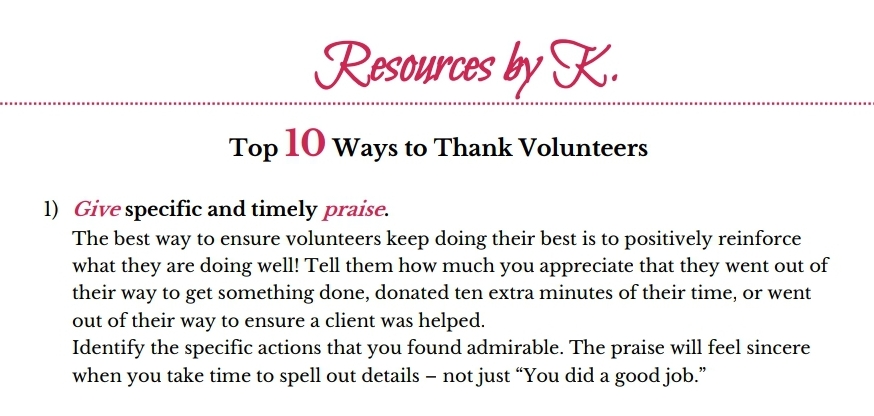
If you want a simple guide to demonstrate to your volunteer supervisors how they can easily improve volunteer relations, download the PDF here and see below for a summary.

How to Thank Volunteers:

  1. Give specific and timely praise.
  2. Say “Thank You.”
  3. Give them the big picture.
  4. Take interest in your volunteers.
  5. Nominate your outstanding volunteers.
  6. Give gifts or tokens of appreciation.
  7. Share your volunteers’ success or use their work as an example.
  8. Ask for your volunteers’ expertise.
  9. Check in with your volunteers.
  10. Prove more opportunity.

Recently I had a conversation with a staff in a supervisory position. I asked who their favourite employee to work with in a particular situation was. She responded, “I don’t have favourites. I like the work that some people do better, but I don’t want to make others feel bad.”

I asked why she didn’t elevate that person, recognize them, and inspire the rest of the staff to work the same. She responded “That doesn’t happen here.” How sad! When this type of attitude is held by management, employees quickly recognize that doing better work offers little extra in return. You help your staff train in apathy.

If you need inspiration in your workplace, contact me. I work with managers and supervisors to help them better coach and manage their staff. It’s as simple (and challenging) as changing the way you provide feedback to your employees. It may require changing your delivery style or implementing new policies in the workplace. It may require shifting your attitude from pessimism to optimism.

Typically, the change you want to see in your staff is one that supervisors and management must make first. I can help you identify your core challenges and create simple yet effective solutions. Whether you need to learn how to foster a culture of appreciation or deliver harsh criticism in a motivating manner. You’re not alone in your challenges, and there is affordable help.

Be the positive change in your workplace. Foster a better a culture. See different results.