Quiz:
How do you set your volunteers and your staff up for success?
Answer:
By providing quality training appropriate to their role.
Why?
Training is essential. It should reflect one’s job description, be organization-specific, provide opportunity for questions and clarification, and ultimately set up your volunteer to succeed.
Organizations and business that fail to train their volunteers and employees often have lower retention or they get stuck with “problem people.”
Ultimately, volunteers want to help your organization – not become an additional burden.
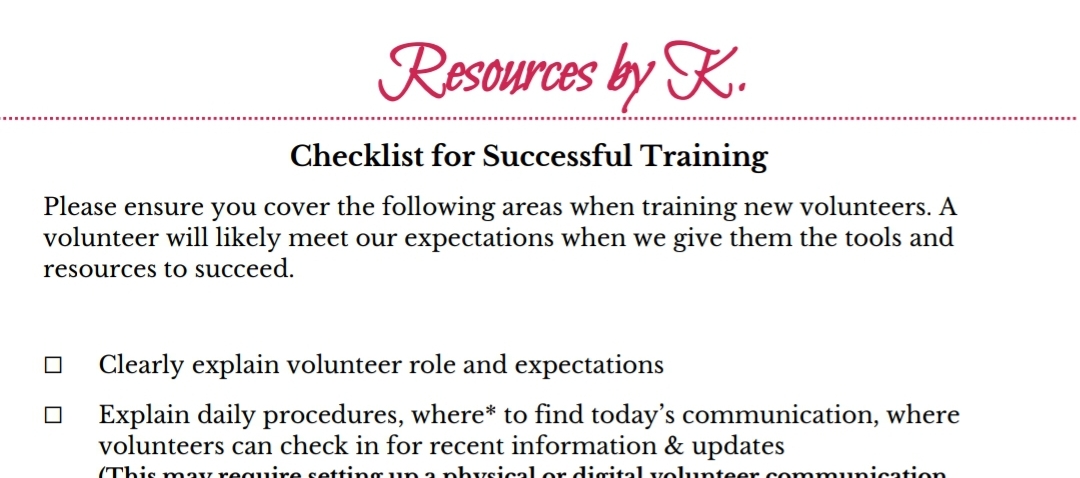
Once you have determined who your volunteer supervisor is, provide them with a checklist that covers all the essentials when it comes to training. Make sure your materials are reviewed regularly so that you’re not sharing outdated information.
What should your training include?
- Explain the job description and your expectations. Be specific and comprehensive.
Ex. If you expect someone to arrive fifteen minutes before their shift starts, state that now. Don’t wait until after they arrive “on time” thinking they’re off to a good start.
- Explain any daily procedures or where volunteers are to find their assigned duties.
Ex. A notebook or log book, a computer with a volunteer login, etc.
- Emphasize any important details or policies.
Ex. “It’s extremely important to keep client confidentiality. This means that certain information does not leave this building. If you have any concerns, please debrief with me at the end of your shift.”
- Health & Safety training.
Ex. Explain any job risks and what to do if injury occurs. Where is the first aid kit located? Will volunteers be using any specific cleaning products? Do they need WHMIS training? Where are the fire extinguishers and emergency exits?
- Introduce volunteer to staff they may need to interact with or explain how they can reach key staff.
Ex. Show them where the phone is and give them a list of important numbers. Clarify everything – does your volunteer understand how to use the phone? Never assume. Face to face introductions are nice so your volunteer doesn’t have to wander around looking for staff.
Your training checklist is especially important if you are a Volunteer Coordinator or Manager delegating this responsibility to another Supervisor.
Reality Check:
It’s wonderful to believe that all people come with amazing skills and initiative, fearlessly ready to jump in wherever needed…but that’s not always the case. A lot of time new volunteers (or staff) need extra encouragement, and every time they need to ask for assistance, it’s another obstacle in their way. Everyone has insecurities, and they may feel silly asking questions like “Where are the fire exits?”
It’s part of your responsibility to train your entire team to make your objectives achievable in the easiest and most efficient way. Good training is essential to:
- Volunteer Retention
- Volunteer Safety
- Volunteer Appreciation
- Volunteer Happiness
- Volunteer Success
- Risk Management
Risk Management is often overlooked or mismanaged. To be a good leader in non profit, be sure that you have appropriately assessed risks at each level of your organization so you can address issues proactively.
Set up your volunteers and volunteer supervisors for success! Create and share your training checklist today or start with mine.


 The Halfwit Writer