Categories
Resource Wednesday

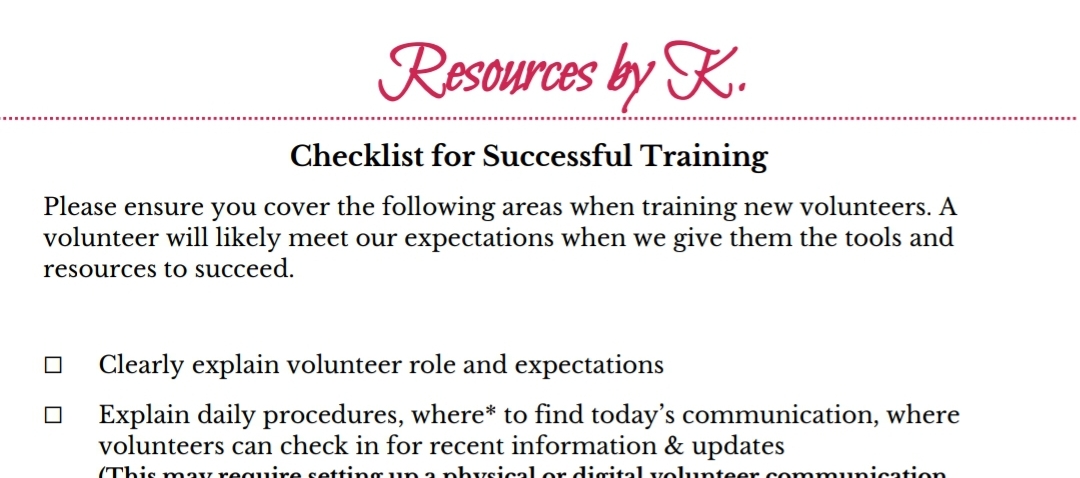
Resource: Training Checklist for Non Profits, Volunteer Supervisors and Managers | RW Issue 3

Quiz:
How do you set your volunteers and your staff up for success?

Answer:
By providing quality training appropriate to their role.

Why?

Training is essential. It should reflect one’s job description, be organization-specific, provide opportunity for questions and clarification, and ultimately set up your volunteer to succeed.

Organizations and business that fail to train their volunteers and employees often have lower retention or they get stuck with “problem people.”

Ultimately, volunteers want to help your organization – not become an additional burden.

Once you have determined who your volunteer supervisor is, provide them with a checklist that covers all the essentials when it comes to training. Make sure your materials are reviewed regularly so that you’re not sharing outdated information.

What should your training include?

  1. Explain the job description and your expectations. Be specific and comprehensive.
    Ex. If you expect someone to arrive fifteen minutes before their shift starts, state that now. Don’t wait until after they arrive “on time” thinking they’re off to a good start.
  2. Explain any daily procedures or where volunteers are to find their assigned duties.
    Ex. A notebook or log book, a computer with a volunteer login, etc.
  3. Emphasize any important details or policies.
    Ex. “It’s extremely important to keep client confidentiality. This means that certain information does not leave this building. If you have any concerns, please debrief with me at the end of your shift.”
  4. Health & Safety training.
    Ex. Explain any job risks and what to do if injury occurs. Where is the first aid kit located? Will volunteers be using any specific cleaning products? Do they need WHMIS training? Where are the fire extinguishers and emergency exits?
  5. Introduce volunteer to staff they may need to interact with or explain how they can reach key staff.
    Ex. Show them where the phone is and give them a list of important numbers. Clarify everything – does your volunteer understand how to use the phone? Never assume. Face to face introductions are nice so your volunteer doesn’t have to wander around looking for staff.

Your training checklist is especially important if you are a Volunteer Coordinator or Manager delegating this responsibility to another Supervisor.

Reality Check:

It’s wonderful to believe that all people come with amazing skills and initiative, fearlessly ready to jump in wherever needed…but that’s not always the case. A lot of time new volunteers (or staff) need extra encouragement, and every time they need to ask for assistance, it’s another obstacle in their way. Everyone has insecurities, and they may feel silly asking questions like “Where are the fire exits?”

It’s part of your responsibility to train your entire team to make your objectives achievable in the easiest and most efficient way. Good training is essential to:

  1. Volunteer Retention
  2. Volunteer Safety
  3. Volunteer Appreciation
  4. Volunteer Happiness
  5. Volunteer Success
  6. Risk Management

Risk Management is often overlooked or mismanaged. To be a good leader in non profit, be sure that you have appropriately assessed risks at each level of your organization so you can address issues proactively.

Set up your volunteers and volunteer supervisors for success! Create and share your training checklist today or start with mine.

Categories
Resource Wednesday

Resource: for Volunteer Supervisors & Non Profit Management | RW Issue 2

If your organization has volunteers, it needs volunteer supervisors. Simple as that. But what does it mean to be a volunteer supervisor? What responsibilities does that role come with? What’s the measurement of success? How does this role impact the entire organization?

If you can answer all these questions, and your values are supported in your workplace, that’s wonderful! Know this is not all work environments. If you need a starting point when outlining this role or communicating it to your staff person, the Volunteer Supervisor Responsibilities document will give you one.

Note to Staff Managers:

It’s important to realize that when you add volunteers to a department for the first time, you must recognize the additional work this places on your staff. Yes, the volunteers are there to alleviate some mundane or redundant work that staff can easily delegate when given the opportunity. However, the staff that supervises them must be given the proper recognition of the time necessary for training, coaching, feedback and evaluation.

Real Talk:

In an organization already overburdened, it’s easy to add additional roadblocks instead of finding real solutions to the overflowing problems. This often includes overlooking the need for proper compensation due to staff with an ever-increasing workload. Change and growth is difficult, because it usually means loss with your gains. Not everyone makes it through. But it is necessary in order to remain sustainable.

Suggestions:

  1. Plan your week so you build in time for strategizing, goal setting, appreciating your staff, etc. During that time, you can complete the next two steps.
  2. Download Volunteer Supervisor Responsibilities resource and read it over.
  3. Draft a version for your own organization. You can adapt this for any role at your workplace if there are aspects that need clarification. You may include it in a new hire package.
  4. Schedule time to talk to the staff that will be working with the volunteers. Review their responsibilities, your expectations, and then open the floor to any concerns and address them right away. Show your support through actions rather than empty words. Keep your door open and engage feedback on a regular basis.

Resource Key Aspects:

  • I start off by appreciating the Volunteer Supervisor, recognizing the importance of their role. It’s important to be genuine if you include acknowledgment like this. I make a point to recognize my colleagues for the work that they do, so it feels natural for me to include this.
  • I have defined terms such as “Volunteer Coordinator” and “Volunteer Supervisor” – two different roles in the organization. You may include different terms as necessary.
  • Numbered list format. My original contained a poem I found inspiring, but I’ve pared this down to its core. Keep your expectations concise. If some responsibilities are not vital to your organization’s mission, don’t include them. Once more, consider the time it will take to perform these additional duties (if they are new to the position) and recognize your staff person accordingly.

Finally:

If you’re already running a volunteer program and you’re having challenges, it may be good to ask:

  • How do we currently supervise volunteers?
  • What training do we provide?
  • What could be improved? What could I improve?
  • Are they being given opportunities to demonstrate their skills?
  • Are they reliable? How are they being screened?
  • How do we provide feedback?
  • How do we say “Thank you!”?

And so on… there are many aspects of your program(s) to be evaluated. It is easy to think, “I don’t have time for that.” But, in reality, you can’t afford not to create an organization designed to grow sustainably. This means working with your most important resource: people. This means scheduling time in your day or week to review, evaluate, and plan. This means cleaning your room.